2026-04-19 — Initial Release v1.0.0.1
UEFIExtract is a Windows x64 utility for parsing and extracting UEFI firmware images. It builds a full tree of Firmware Volumes, FFS files, and sections — with transparent decompression of Tiano and LZMA-compressed sections. Supports IFR/HII package extraction, BIOS setting offset search (
biosfind), Intel FIT parsing, and live BIOS flash read via FPTW64 (readbios). Runs in both GUI and CLI mode from the same binary.
UEFIExtract — UEFI Firmware Parser and Extractor
📚 Table of Contents
- Overview
- Architecture
- CLI Reference
- GUI Reference
- Firmware Parsing
- Compression Support
- Vendor Wrapper Detection
- IFR Extraction
- PE/TE Analyzer
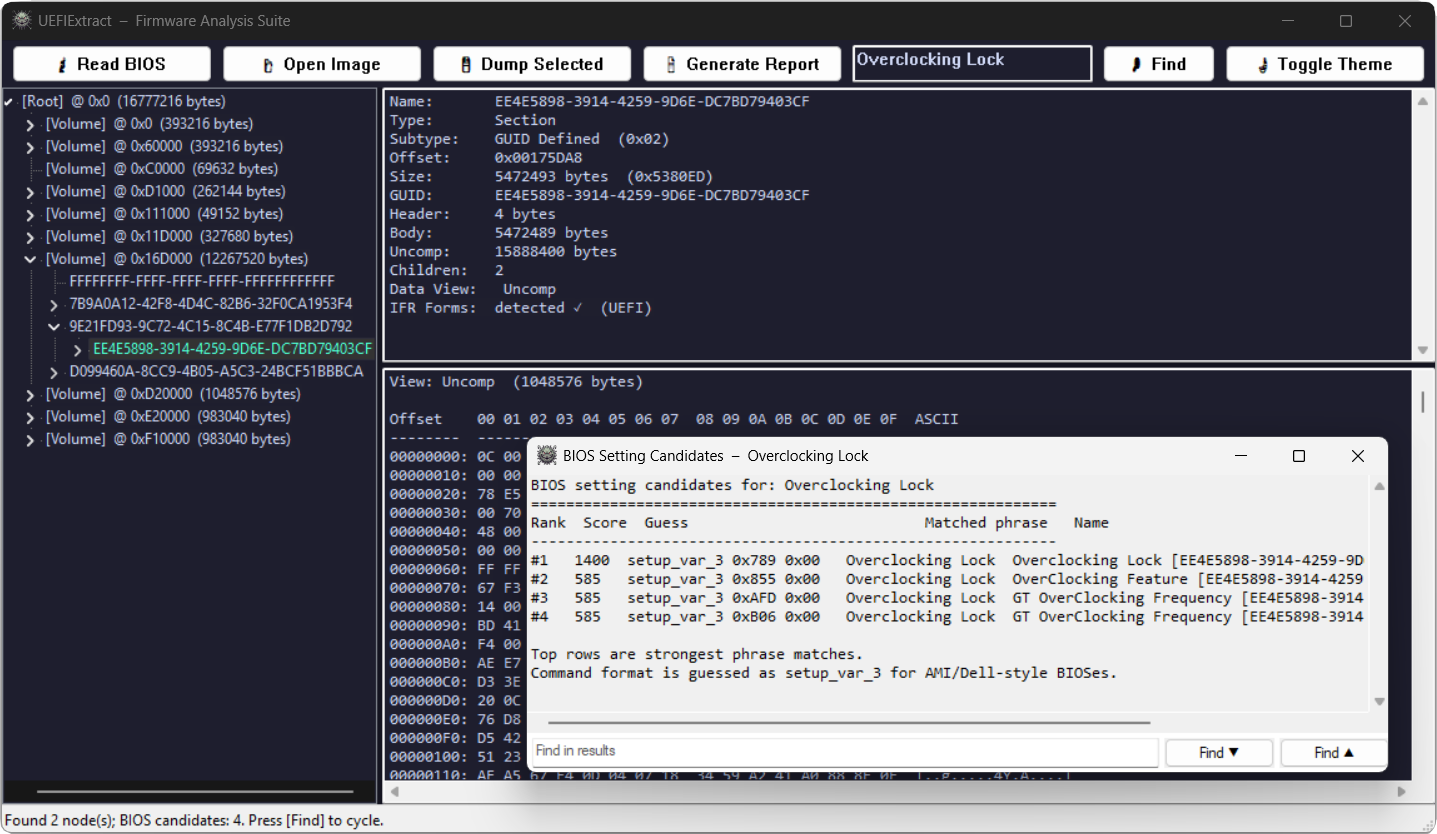
- BIOS Setting Finder
- Search Engine
- Intel FIT Parser
- Live BIOS Read (readbios)
- Dump Modes
- Report Generator
- Surgical Patching
- Build System
- Source Code Structure
- Error Codes
- Troubleshooting
Overview
UEFIExtract parses UEFI firmware images into a structured tree of nodes and provides multiple extraction and analysis operations on that tree.
| Capability | Description |
|---|---|
| Firmware tree parsing | Full Volume → File → Section hierarchy from raw .rom, .bin, or vendor update packages |
| Transparent decompression | EFI Standard (Tiano) and LZMA sections decoded automatically during parsing |
| IFR / HII extraction | Detects EFI and UEFI IFR protocol variants; dumps human-readable form text |
| BIOS setting finder | Text-query search over decoded IFR output to locate setup_var variable offsets |
| Intel FIT parsing | Reads microcode revisions, Startup ACM, TPM policy, and BootGuard KM/BP entries |
| Live flash read | readbios: detects Intel PCH via SetupAPI, extracts matching FPTW64 from bundled archive, dumps BIOS region. Parsing of .rom files works on any UEFI FFS image regardless of CPU vendor. |
| Targeted GUID extraction | Extract a specific FFS file by GUID, with optional section type filter and dump mode selection |
| Surgical patching | Replace a node's body in-place; recomputes FFS integrity checksum when FFS_ATTRIB_CHECKSUM is set |
| GUI + CLI | Single binary: no arguments → GUI (Win32, DWM/Mica); any other argument → CLI |
What UEFIExtract Does NOT Do
- ❌ No re-compression —
PatchNode()replaces body bytes in-place at original size; compressing and rebuilding a section is not supported - ❌ No live flash read on AMD —
readbiosrequires Intel PCH + MEI; parsing a.romfile from any platform (Intel, AMD, ARM) works normally viaFfsParser - ❌ No Linux / macOS — Windows x64 only (Win32, SetupAPI, DWM)
- ❌ No automatic NVRAM writing —
biosfindonly locates offsets; writing is left to external tools (e.g.setup_var,UnderVolter)
Architecture
CLI Reference
The binary uses WinMain as its entry point. When launched with arguments it calls AttachConsole(ATTACH_PARENT_PROCESS) or AllocConsole() as needed, then routes through RunCli(). Version string is 2.0.0.
UEFIExtract {-h|--help|-v|--version}
UEFIExtract <image>
UEFIExtract <image> all
UEFIExtract <image> dump
UEFIExtract <image> report
UEFIExtract <image> guids
UEFIExtract <image> ifrscan [-o <dir>]
UEFIExtract <image> biosfind <query> [-o <txt>]
UEFIExtract <image> <GUID> [-o <outfile>] [-m <mode>] [-t <type>]
UEFIExtract readbios [-o <output.rom>]| Command | Output |
|---|---|
<image> |
Report (.report.txt) + GUID CSV (.guids.csv) + leaf dump (.dump\) |
<image> all |
Report + GUID CSV + full dump with subdirectories |
<image> dump |
Extraction only — no report, no GUID CSV |
<image> report |
Text report only |
<image> guids |
GUID CSV only |
<image> ifrscan [-o <dir>] |
Scans all tree nodes for IFR; prints matches; optionally dumps .ifr.txt files to <dir> |
<image> biosfind <query> |
Finds BIOS setup variable candidates from IFR; see BIOS Setting Finder |
<image> <GUID> ... |
Targeted extraction — accepts multiple GUIDs, each with its own -o, -m, -t |
readbios |
Detect PCH, run FPTW64, dump BIOS region, then parse and report |
Targeted GUID Extraction Flags
| Flag | Values | Description |
|---|---|---|
-o <path> |
file or directory path | Output path for this GUID target |
-m <mode> |
all body header unc_data info file |
Data to extract; see Dump Modes |
-t <type> |
hex byte, e.g. 0x10 |
Filter by EFI section type; 0xFF = no filter (default) |
Multiple GUIDs can be listed on one command line; each reads its own -o/-m/-t after it.
Console Attach Strategy
The binary is compiled as a GUI subsystem application (WinMain). When invoked from a shell with arguments, it calls AttachConsole(ATTACH_PARENT_PROCESS). If that fails (e.g. an elevated process that lost its parent), it falls back to AllocConsole(). Stdout, stderr, and stdin are reopened to CONOUT$ / CONIN$ accordingly.
After CLI work completes, if the console was attached (not allocated), the function InjectEnterToConsole() writes a synthetic VK_RETURN key-down + key-up pair into the console input buffer via WriteConsoleInputW. This causes the parent shell (CMD, PowerShell) to redraw its prompt — without it, the cursor blinks indefinitely because the shell already printed the prompt before the GUI-subsystem process returned. If the console was allocated (new window), FreeConsole() is called instead so the window closes cleanly.
0 on success. Non-zero ErrorCode value on failure (see Error Codes).
GUI Reference
Launched when no arguments are passed (or with --gui / -g). Built on ModernWindow — a Win32 window class with DWM Mica styling. Defaults to dark mode; toggleable at runtime via Dark Mode button.
Controls
| Control | Description |
|---|---|
| Open | File open dialog (BrowseForFile) — loads a firmware image |
| Dump | Dumps the currently selected node using the Current dump mode |
| Report | Generates text report for the loaded image |
| Read BIOS | Runs the readbios pipeline; requires the data archive next to the EXE |
| Dark Mode | Toggles SetDarkMode(bool) — updates DWM attributes and repaints all controls |
| Search box + Search | Runs SearchEngine::SearchAll() over the tree; results are highlighted and cycled |
| Tree | Hierarchical view of all parsed nodes (Volume / File / Section / FreeSpace) |
| Details pane | Shows node type, subtype, offset, size, GUID, name, info strings, and IFR text if applicable |
| Hex pane | Raw hex dump of the selected node's data |
| Progress bar | Used during readbios FPTW64 execution; updated via WM_APP+1 message |
| Status bar | Running status messages |
Context Menu (right-click on tree node)
| Action | Description |
|---|---|
| Extract IFR | Calls ExtractIFR() on the node's best available data view; shows result in details pane |
| Dump Node | Dumps the selected node to disk using a folder browser |
| Replace Body | Opens a file dialog, loads the file as new body data, calls FirmwareImage::PatchNode() |
IFR Visual Hinting and Text Cache
Nodes that contain detectable IFR packages are indicated in the tree using a lazy-evaluated cache (m_ifrCache). Detection uses IsIfrCandidate() which scans the first 2 MB of a node's data for EFI/UEFI IFR protocol markers. The cache is keyed by TreeNode* and is cleared on each image reload in PopulateTree().
A separate m_ifrTextCache stores the full ExtractIFR() text output per node. On the first access (e.g. via Extract IFR or a biosfind search), the text is parsed once and stored. All subsequent accesses for the same node return the cached string immediately — avoiding repeated IFR decode passes during interactive search.
Splitters
Two draggable splitters: vertical (m_splitX, default 300 px) separating the tree from the right panes; horizontal (m_splitY, default 220 px) separating details from hex. Minimum pane width/height: 80 px / 40 px.
Firmware Parsing
FirmwareImage
FirmwareImage::FromFile() reads the entire file into a ByteBuffer, runs vendor detection, and strips the wrapper if found (see Vendor Wrapper Detection). The buffer is then handed to FfsParser::Parse(). Decompressed section data is stored in m_ownedBuffers; TreeNode objects hold non-owning ByteView spans into these buffers.
FfsParser
Scans the image for Firmware Volume headers (_FVH signature 0x4856465F). For each valid volume, enumerates FFS files and recurses into sections. Decompression is triggered inline when a Compression or GUID-Defined section is encountered.
Node Tree
Each node carries:
| Field | Type | Description |
|---|---|---|
type() |
NodeType |
Root, Volume, File, Section, FreeSpace — free space between FFS files within a volume is represented as a distinct node type, not silently discarded |
subtype() |
uint8_t |
Cast to VolumeSubtype, FileSubtype, or SectionSubtype |
offset() |
uint64_t |
Byte offset within the firmware image |
size() |
uint64_t |
Total node size in bytes (includes header) |
guid() |
Guid |
EFI GUID (16 bytes, little-endian layout); valid if hasGuid() is true |
name() |
std::wstring |
GUID string or human-readable name |
text() |
std::wstring |
User Interface section string (module name) |
info() |
std::wstring |
Supplemental info (version string, dependency expression, etc.) |
header() |
ByteView |
Non-owning view of the raw header bytes |
body() |
ByteView |
Non-owning view of the payload bytes |
tail() |
ByteView |
Non-owning view of any trailing bytes |
uncompressedData() |
ByteView |
Non-owning view of decompressed data (empty if section is not compressed) |
Volume Subtypes
| Subtype | String |
|---|---|
Ffs1 |
FFSv1 |
Ffs2 |
FFSv2 |
Ffs3 |
FFSv3 |
File Subtypes
| Subtype | Notes |
|---|---|
| Raw | |
| FreeForm | |
| SecurityCore | SEC phase |
| PEICore | Pre-EFI Init core |
| DXECore | Driver Execution Environment core |
| PEIM | PEI module |
| Driver | DXE driver |
| Combined PEIM/Driver | |
| Application | UEFI application |
| SMM | System Management Mode driver |
| VolumeImage | Embedded FV |
| Combined SMM | |
| MM Core | |
| MM Standalone | |
| MM Combined | |
| Pad | Padding file |
Section Subtypes
| Subtype | Notes |
|---|---|
| Compression | Contains Tiano or LZMA compressed payload |
| GUID Defined | GUID-tagged section; triggers decompression if LZMA GUID matches |
| Disposable | |
| PE32 | x64 PE image |
| PIC | Position-independent code |
| TE | Truncated PE (terse executable) |
| DXE Dependency | Dependency expression for DXE phase |
| Version | Version string (read into node.info()) |
| User Interface | Module name string (read into node.text()) |
| Firmware Volume Image | Nested FV |
| Freeform GUID | |
| Raw | |
| PEI Dependency | |
| SMM Dependency | |
| MM Dependency |
Compression Support
| Algorithm | Trigger |
|---|---|
| EFI Standard (Tiano) | Compression section with EFI standard compression type |
| LZMA | GuidDefined section whose GUID matches the known LZMA GUID; uses LZMA SDK (7-Zip) v24.x |
Both decompressors are called from FfsParser and the result is stored as an owned ByteBuffer in FirmwareImage::m_ownedBuffers. The node's uncompressedData() view points into that buffer.
The LZMA implementation bundles the LZMA SDK C files (LzmaDec.c, Bra.h, 7zTypes.h) directly in the source tree under src/Compression/SDK/C/.
Vendor Wrapper Detection
VendorLoader.hpp detects known firmware packaging formats before the FFS parser runs:
| Wrapper | Detection Criterion | Unwrap Strategy |
|---|---|---|
| Dell/HP/Lenovo EXE | First two bytes are MZ |
Scan 512-byte-aligned offsets for Intel FD magic (5A A5 F0 0F at offset+16) or _FVH signature |
| UEFI Capsule | First 16 bytes match GUID {3B6686BD-0D76-4030-B70E-B5519E2FC5A0} |
Skip capsule header (HeaderLength at offset 20) |
| HP HPQOEM | First 6 bytes are ASCII HPQOEM |
Same scan as EXE wrapper |
If unwrapping succeeds, only the inner payload is parsed; FirmwareImage::wrapperInfo() holds the wrapper name string.
IFR Extraction
Internal Forms Representation (IFR) is the binary encoding of UEFI HII setup forms stored inside firmware.
Protocol Detection
IFRBridge::DetectProtocol() distinguishes two variants:
| Protocol | Identifier |
|---|---|
EFI |
Legacy EFI IFR encoding |
UEFI |
PI/UEFI IFR encoding (UEFI 2.1+) |
IsIfrCandidate() limits scanning to the first 2 MB of any node's data as a fast pre-filter before committing to full extraction.
ifrscan Output Format
[N] IFR <Protocol> <NodeType> / <SectionSubtype> @ 0x<offset> size=0x<size> data=<body|uncompressed> <displayName>With -o <dir>, each match is saved as <displayName>.ifr.txt. A ifrscan_summary.txt index is always written to the output directory.
PE/TE Analyzer
PeAnalyzer runs automatically in the GUI details pane (UpdateDetailsPane) whenever a PE32 or TE section node is selected. It parses the image header and displays:
| Field | PE32 | TE |
|---|---|---|
| Image type | Image: PE32 (x86) or PE32+ (x64) |
Image: TE (x64) etc. |
| Entry RVA | Entry RVA: 0x<addr> from AddressOfEntryPoint |
Entry RVA: 0x<addr> adjusted for TE stripped header offset |
TE (Terse Executable) is a stripped PE format used by PEI and some DXE modules to minimise image size. The analyzer handles both formats via separate AnalyzePe() and AnalyzeTe() functions. This is independent of IFR detection — it activates on section type alone.
BIOS Setting Finder
biosfind automates the lookup of BIOS setup variable offsets from IFR text. This is the equivalent of manually grepping IFR dumps for CFG Lock, overclocking settings, or any other NVRAM variable.
Query Parsing
The query string is split on ,, ;, \n, and \r. Each phrase is independently normalized (lowercased, non-alphanumeric replaced with spaces) and tokenized. Generic tokens (lock, setting, option, feature, mode, state, enable, disable, support, control) carry a scoring penalty.
Scoring Algorithm
| Match Type | Base Score |
|---|---|
| Exact normalized match | 1400 |
| Prefix match | 1200 |
| Substring match | 1050 |
| All query tokens matched | base + 420 |
| Per matched token | +110 |
| Per word-boundary (prefix) token | +35 |
| Per generic token matched | −90 |
Minimum score threshold for a candidate to be included: 260.
Candidate Extraction
Candidates are extracted from IFR text using two regular expressions:
(Setting|Checkbox|Numeric|Password):\s+(.+?),\s+Variable:\s+0x([0-9A-Fa-f]+)
Numeric:\s+(.+?)\s+\([^)]*\),\s+Variable:\s+0x([0-9A-Fa-f]+)
Variable: 0x0 entries are always discarded. Deduplication key: kind:offset:name.
Output Format
#Rank Score setup_var_3 0x<offset> 0x00 <matchedPhrase> <name> [<nodeName> | <protocol>]Up to 24 candidates are printed; additional results are indicated by a count message. The command format shown (setup_var_3) is a heuristic for AMI/Dell-style BIOSes.
Search Engine
SearchEngine supports four pattern kinds, all auto-detected from the query string:
| Kind | Detection | Matching |
|---|---|---|
| GUID | String length ≥ 36, dashes at positions 8/13/18/23 | 16-byte EFI little-endian layout (Data1 LE, Data2 LE, Data3 LE, Data4 BE) |
| Hex | All space-separated tokens are exactly 2 hex digits or ?? |
Exact bytes with optional ?? wildcard positions |
| ASCII | Fallback for non-GUID, non-hex input | Case-insensitive byte scan |
| Unicode | Paired with ASCII for plain-text queries | Case-insensitive UTF-16LE scan |
Plain text queries (AutoDetectAll) generate both an ASCII and a Unicode pattern and search with both simultaneously.
Matching Details
- Exact hex without wildcards — uses
std::boyer_moore_horspool_searcherfor fast bulk scan. - Wildcards (
??) — linear scan with per-byte mask check. - Case-insensitive ASCII —
std::tolowerper byte against lowercased pattern bytes. - Case-insensitive Unicode — 2-byte wide-char units folded via
std::towlower.
Search Scope
Each node is searched across three data views:
body()— raw payloadheader()— only whensearchHeaders = trueuncompressedData()— if non-empty (decompressed content)
Node metadata (name(), text()) is also checked for text and Unicode patterns; metadata matches report matchOffset = 0.
Intel FIT Parser
FitParser.hpp locates and decodes the Intel Firmware Interface Table present in SPI flash images.
FIT Pointer Location
The FIT pointer is a 64-bit physical address stored at image_base + image_size - 0x40. The image is assumed to map to the physical range [0x100000000 - image_size, 0x100000000).
FIT Entry Types
| Type Code | Name | Notes |
|---|---|---|
0x00 |
Header | Entry count in Size[23:0] |
0x01 |
Microcode | Reads CPUID (offset +12), revision (offset +4), date (offset +8). Date is BCD-encoded: bits [31:24] = month, [23:16] = day, [15:0] = year — displayed as Date=MM/DD/YYYY |
0x02 |
Startup ACM | Size in 64-byte granules from Size[23:0] |
0x07 / 0x08 |
BIOS Startup Module | Physical address only |
0x0C |
TPM Policy | Presence flag |
0x10 |
BootGuard KM | Key Manifest physical address |
0x11 |
BootGuard BP | Boot Policy physical address |
BootGuard Status
| Condition | Output |
|---|---|
| Both KM and BP entries present | BootGuard: ENABLED (KM + BP present) |
| Only one of KM / BP | BootGuard: PARTIAL |
| Neither present | BootGuard: not detected |
FIT output is appended to the GUI details pane when an image is loaded.
Live BIOS Read
readbios reads the BIOS SPI flash region from a running Intel platform using Intel's Flash Programming Tool (FPTW64).
Prerequisites
| Requirement | Details |
|---|---|
| Administrator rights | Required for Intel MEI driver access via SetupAPI |
| Intel platform | PCH detection queries PCI devices via SetupAPI |
data archive |
Must be present next to UEFIExtract.exe; download from https://kvc.pl/data |
Execution Flow
DetectPch()— scans PCI devices, returnsPchInfowithfptwName(e.g.FPTW64_CSME_v12r38.exe) andmeVersionstring.RunFptw()— extracts the matching FPTW64 executable from the bundled in-memory 7z archive, runs it, monitorsstdoutfor percentage lines (progress callback 0–100).- On success, the dumped ROM is saved (default:
bios_dump.romnext to the EXE, or-o <path>). - The ROM is then parsed by
FfsParserand a report + dump are generated automatically.
CLI Progress Display
The prefix Reading BIOS: is printed once. A 7-character dynamic suffix (NNN% <spinner>) is updated at 100 ms intervals by backspacing over the previous value. The spinner characters are -\|/.
Common Failure Causes
- Not running as Administrator
- MEI driver not installed or disabled in BIOS
- Flash descriptor has BIOS region read protection enabled (common on locked OEM systems)
Dump Modes
FirmwareDumper supports six extraction modes controlled by DumpOptions::mode:
| Mode | Enum | Files Written |
|---|---|---|
Current |
Default (no second arg) | Header + body for leaf nodes; .info.txt for all |
All |
all |
Header + body + uncompressed + .info.txt; creates subdirectories per node |
Header |
header |
Raw header bytes only |
Body |
body |
Raw body bytes only |
Uncompressed |
unc_data |
Decompressed data (falls back to body if not compressed) |
Info |
info |
.info.txt text summary only |
File |
file |
Complete FFS file (header + body + tail) |
File Naming
FileNamingStrategy generates names from the node's text, name, or GUID string. Illegal filesystem characters are stripped. Collisions are resolved by appending a counter suffix. Extended names are enabled by default.
Filters
DumpOptions::guidFilter — if non-empty, only nodes whose GUID string matches are dumped.
DumpOptions::sectionTypeFilter — if not 0xFF, only sections whose raw type byte matches are dumped.
Report Generator
ReportGenerator produces two output formats from the parsed tree:
| Output | File | Format |
|---|---|---|
| Text report | <image>.report.txt |
Indented tree with node type, subtype, offset, size, GUID, name, text, info; UTF-8 |
| GUID CSV | <image>.guids.csv |
One row per node that has a GUID: GUID, NodeType, Name; UTF-8 |
Both are generated by the default <image> command and by <image> all. Each can be requested independently with the report or guids sub-commands.
Surgical Patching
FirmwareImage::PatchNode() replaces a node's body bytes in the original buffer.
Constraints
newBody.size()must be ≤node.body().size(). Expansion is not supported.- Bytes from
newBody.size()tonode.body().size()are filled with0xFF(erased flash state).
Checksum Update
When the FFS file header has FFS_ATTRIB_CHECKSUM (bit 0x40) set in the Attributes byte (offset 19 of the 24-byte FFS header), the IntegrityCheck.File byte (offset 17) is recomputed:
IC1 = (uint8_t)(0 - sum_of_all_body_bytes)This maintains the invariant sum(body) + IC1 = 0 mod 256. The IntegrityCheck.Header byte (offset 16) is computed over the header with IC1 = 0 and is therefore unaffected by body changes.
The GUI exposes this via the Replace Body context menu item.
Build System
| Property | Value |
|---|---|
| Project file | UEFIExtract.vcxproj |
| Toolset | MSVC v145 (Visual Studio 2026) |
| Standard | C++23 (std::expected, std::format, std::span) |
| Platform | x64 |
| Configuration | Release |
| Output | bin\x64\Release\UEFIExtract.exe |
| Subsystem | Windows GUI (WinMain) — CLI attaches/allocates console at runtime |
| Build script | build.ps1 (PowerShell) — locates Visual Studio via vswhere.exe, calls MSBuild with /t:Rebuild /m /v:minimal. The /t:Rebuild target always performs a clean build (delete + compile), never an incremental build. Cleans obj\ on success. |
Building
.\build.ps1Requires Visual Studio 2026 with the C++ Desktop workload and vswhere.exe present in %ProgramFiles(x86)%\Microsoft Visual Studio\Installer\.
Dependencies
All dependencies are bundled in the source tree; no package manager or external download is required at build time.
| Dependency | Location | Purpose |
|---|---|---|
| LZMA SDK (7-Zip) | src/Compression/SDK/C/ |
LZMA decompression |
| EFI Tiano decompress | src/Compression/EfiTianoDecompress.c |
Tiano/EFI standard decompression |
| Win32 / DWM | System | Window management, console, PCH detection |
Source Code Structure
src/
├── main.cpp                     Entry point: mode dispatch, console attach/inject-Enter
├── CliRunner.cpp / .hpp         CLI command parsing and dispatch
├── Analysis/
│   ├── BiosSettingFinder.hpp    biosfind: query parser, scorer, candidate extractor
│   ├── FitParser.hpp            Intel FIT parser (header-only)
│   ├── PeAnalyzer.cpp / .hpp    PE/TE image analysis helpers
│   └── SearchEngine.hpp         Multi-pattern search engine (header-only)
├── Common/
│   ├── ErrorHandling.hpp        ErrorCode enum, Result<T> = std::expected<T, ErrorCode>
│   ├── GuidUtils.hpp            GUID ↔ string conversion
│   ├── StringUtils.cpp / .hpp   UTF-8 / wide string conversion
│   ├── Types.hpp                ByteBuffer, ByteView, Guid, String type aliases
│   └── WinApiUtils.cpp / .hpp   File I/O, directory creation, full path resolution
├── Compression/
│   ├── EfiTianoDecompress.c / .h   EFI standard (Tiano) decompressor
│   ├── LzmaDecompress.c / .h       LZMA wrapper
│   ├── UefiDecompressor.cpp / .hpp High-level decompress API
│   └── SDK/C/                      LZMA SDK (7-Zip) C sources
├── Dumper/
│   ├── FileNamingStrategy.cpp / .hpp  Node → filename generation with collision avoidance
│   └── FirmwareDumper.cpp / .hpp      Tree walk → file extraction
├── Firmware/
│   ├── FfsParser.cpp / .hpp     FV + FFS + Section recursive parser
│   ├── FirmwareImage.cpp / .hpp Image load, buffer ownership, PatchNode()
│   ├── NodeType.cpp / .hpp      NodeType / VolumeSubtype / FileSubtype / SectionSubtype enums
│   ├── TreeNode.hpp             Node data model (type, GUID, views, children)
│   └── VendorLoader.hpp         Vendor wrapper detection and stripping (header-only)
├── IFR/
│   ├── EFI.cpp / .h             EFI IFR protocol decoder
│   ├── IFRBridge.cpp / .hpp     Protocol detection, ExtractIFR() entry point
│   ├── UEFI.cpp / .h            UEFI IFR protocol decoder
│   └── util.h                   IFR utility types
├── Report/
│   └── ReportGenerator.cpp / .hpp  Text report and GUID CSV generation
├── UI/
│   ├── MainWindow.cpp / .hpp    Application main window: controls, tree, hex, search, IFR
│   └── ModernWindow.cpp / .hpp  Win32 base window with DWM/Mica styling
└── Utils/
    ├── FptwRunner.cpp / .hpp    FPTW64 extraction from 7z archive + execution + progress
    └── PchDetect.cpp / .hpp     Intel PCH detection via SetupAPI
Error Codes
RunCli() and most internal operations return or propagate these codes as process exit values:
| Code | Numeric | Meaning |
|---|---|---|
Success |
0 | Operation completed successfully |
FileNotFound |
1 | Input file does not exist |
FileOpenFailed |
2 | File could not be opened |
FileReadFailed |
3 | Read error during file load |
FileWriteFailed |
4 | Could not write output file |
DirCreateFailed |
5 | Output directory creation failed |
InvalidParameter |
8 | Null pointer or out-of-bounds argument |
ItemNotFound |
9 | GUID target not found in tree |
ParseError |
10 | No FFS volumes found, or tree root unavailable |
UnsupportedFormat |
11 | Unrecognised firmware format |
BufferTooSmall |
12 | PatchNode: new body larger than original |
Troubleshooting
"No UEFI firmware volumes found"
Symptom: CLI prints the error and exits with ParseError.
Solutions:
- Verify the file is a raw UEFI SPI dump, not a compressed update package. Try the vendor's own extraction tool first if the file has an
.exeor.cabextension. - If it is an EXE-based update, UEFIExtract's vendor unwrapper scans 512-byte-aligned offsets for
_FVHor Intel FD magic. A non-standard update format may not be detected — in that case extract the raw ROM manually with 7-Zip orbinwalk. - Confirm the file is not truncated: a typical full BIOS dump is 4–32 MB.
IFR Scan Returns No Matches
Symptom: ifrscan reports No IFR matches found.
Solutions:
- Some BIOS images store HII resources only in compressed sections. Verify the image parsed correctly and that the report shows
CompressionorGUID Definedsections — these are decompressed automatically and should contain IFR. - Very old BIOSes (pre-UEFI) may use vendor-specific form encoding not covered by EFI or UEFI IFR protocols.
biosfind Returns No Candidates
Symptom: Command exits with No BIOS setting candidates found.
Solutions:
- Run
ifrscanfirst to confirm IFR is present at all. - The minimum score threshold is 260. Try a shorter or more specific query — single distinctive words outperform phrases containing generic tokens (
lock,enable,mode). - If multiple phrases are needed, separate them with commas:
UEFIExtract image.rom biosfind "CFG Lock, overclocking lock".
readbios Fails: PCH Not Detected
Symptom: Error: Intel PCH not detected via SetupAPI.
Solutions:
- Run only on Intel platforms. AMD systems are not supported.
- Confirm Intel MEI/ME driver is installed (visible in Device Manager as "Intel Management Engine Interface").
- Some virtualized environments do not expose the PCH PCI device — run on physical hardware.
readbios Fails: FPTW64 Error
Symptom: Error: FPTW64 failed to dump BIOS.
Solutions:
- Run
UEFIExtract.exeas Administrator. FPTW64 requires direct hardware access. - Confirm
dataarchive is present next to the EXE. If missing, download fromhttps://kvc.pl/data. - Some platforms have the BIOS region locked in the flash descriptor. In that case FPTW64 exits with a region access error — the lock can sometimes be lifted by enabling an OEM unlock option in BIOS settings, or by using an unlocked descriptor (advanced, hardware risk).
GUID Targeted Extraction: 0 Items Dumped
Symptom: [+] Target {GUID} dumped 0 items to: ...
Solutions:
- Verify the GUID string format:
XXXXXXXX-XXXX-XXXX-XXXX-XXXXXXXXXXXX. Curly braces are accepted but not required. - Run
guidssub-command first to obtain the exact GUID strings present in the image:UEFIExtract image.rom guids. - Check
-t <type>filter — if set, only matching section types within the file are extracted. Omit-tto extract everything.
Patched Image Fails to Boot
Symptom: After Replace Body, the firmware does not boot.
Considerations:
- Only the body bytes and the FFS
IntegrityCheck.Filefield are updated. Secure Boot signatures and other integrity measurements (BootGuard BP hash) are not recomputed — a modified image will fail measured boot on BootGuard-protected platforms. - The replacement body must fit within the original body size. Larger bodies are not supported.
- Decompressed section contents cannot be re-compressed — patching works only on uncompressed sections.
License
Apache License 2.0
Full text available in project repository (LICENSE file).
Disclaimer
WARNING: This tool accesses raw firmware data and can interact with system hardware (FPTW64 flash read). It is provided for research, analysis, and educational purposes. Incorrect use — especially with
readbioson locked or production systems — may result in system instability. Use at your own risk.
All trademarks, logos, and brand names are the property of their respective owners. Intel, Management Engine, and related marks are trademarks of Intel Corporation.
Last updated: 2026-04-19